The Role of Balance Cushion Posture: A Complete Guide
A balance cushion is defined as an inflatable disc that creates controlled instability beneath your body, forcing your core and spinal stabilizing muscles to engage continuously during seated activities. This is the core role of balance cushion posture: it replaces passive, static sitting with active sitting that keeps your muscles working. Standard balance cushions measure 14 inches (35 cm) in diameter and support up to 250 lbs, making them practical for most desk setups. If you spend eight or more hours a day in a chair, this small disc can change how your body feels by 5 PM.
How does a balance cushion improve posture through active sitting?
The physiological mechanism behind improving posture with cushions comes down to one concept: proprioception. Proprioception is your body’s ability to sense its own position in space. When you sit on an unstable surface, your nervous system receives constant feedback signals and responds by making micro-adjustments to keep you upright.
Balance cushions function as proprioceptive feedback tools, preventing the body from “shutting down” during static sitting through continuous neuromuscular adjustments. Static sitting on a flat chair allows your postural muscles to go dormant. A balance cushion keeps them switched on.
The benefits of balance cushions go beyond just keeping you awake in your chair. Here is what happens inside your body when you sit on one:
- Core activation: Your transverse abdominis and multifidus muscles fire continuously to stabilize your spine against the cushion’s subtle sway.
- Hip engagement: Your hip stabilizers work to keep your pelvis level, which directly supports lumbar alignment.
- Spinal decompression: Micro-movements shift load distribution across spinal discs, reducing the compression that builds during hours of static sitting.
- Neuromuscular retraining: Repeated exposure to the unstable surface teaches your nervous system to default to better alignment even when you are off the cushion.
The primary role of balance cushions is to increase joint position awareness and prevent muscle stagnation, rather than merely building raw strength. That distinction matters. You are not doing a workout. You are retraining your nervous system to recognize and maintain a neutral spine automatically.
Physical therapists stress that balance cushions enhance joint awareness and prevent muscle stagnation, but they are not standalone fixes for poor desk posture. The cushion is a tool. Your habits, your chair height, and your screen position all still matter.
Pro Tip: If you notice yourself gripping your chair arms or tensing your shoulders while sitting on the cushion, your core is fatiguing. Take a five-minute break on a flat surface before returning.
What are the best practices for using a balance cushion to correct posture?
Using a balance cushion incorrectly produces muscle fatigue instead of posture improvement. The right approach is progressive and deliberate.
- Start with one hour per day. Beginners should use a balance cushion for about 1 hour daily, gradually increasing duration as stabilizing muscles adapt. Jumping straight to an eight-hour workday on the cushion overloads muscles that are not yet conditioned.
- Adjust inflation to match your level. Higher air pressure reduces sway, while lower inflation increases postural challenge and demands greater core activation. Start firmer and deflate gradually as your strength builds.
- Apply the 90-degree ergonomic rule. The 90-degree rule for elbows, hips, and knees remains the ergonomic baseline for desk posture. A balance cushion does not replace this. Your feet should be flat on the floor, your knees level with your hips, and your elbows resting at desk height.
- Begin seated before standing. Starting seated use before attempting to stand on a balance cushion is advisable for most people. This builds confidence and activates trunk muscles without injury risk.
- Alternate with flat sitting. Spending your entire day on the cushion is counterproductive. Alternate between the cushion and your regular chair to let muscles recover and consolidate the retraining signal.
Common mistakes include over-inflating the cushion (which reduces its effectiveness), sitting too far forward on it (which shifts load to the thighs instead of the core), and ignoring screen height (which causes neck strain that no cushion can fix).
Overuse without gradual adaptation can lead to muscle fatigue rather than benefit. Progressive retraining protocols exist for a reason. Respect the adaptation curve.
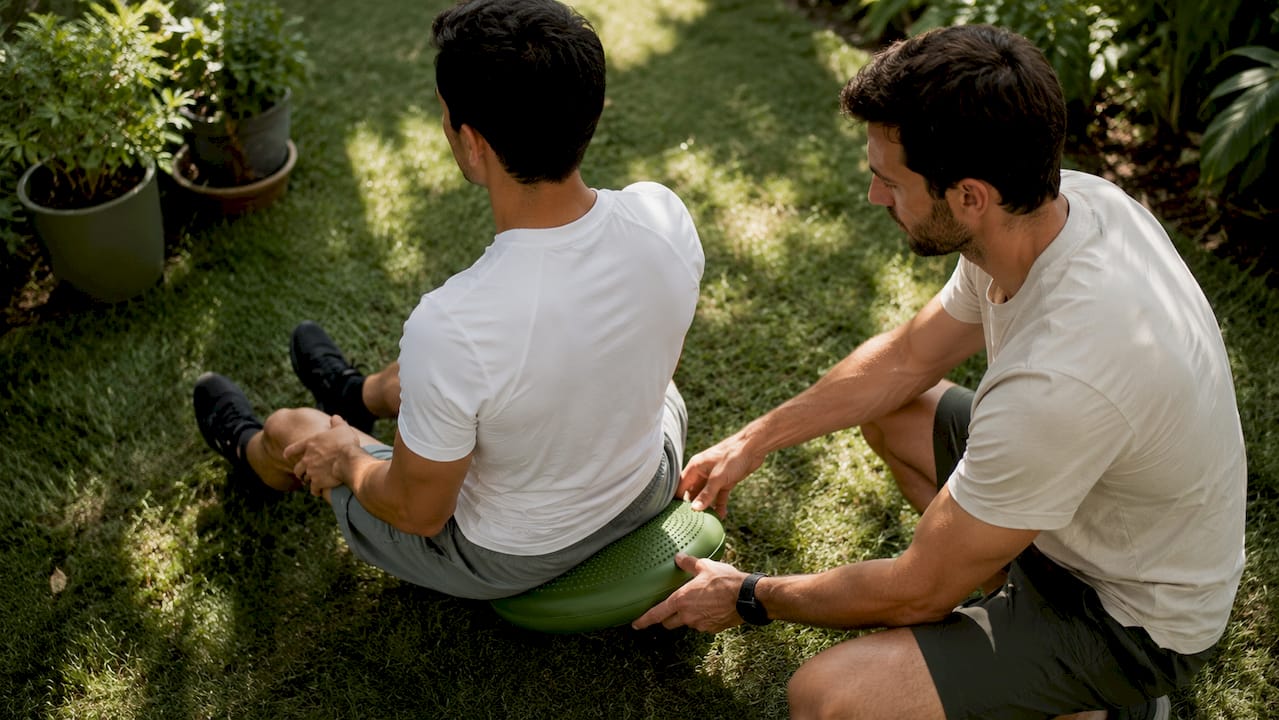
Pro Tip: Mark your inflation level with a permanent marker on the valve cap. This lets you return to the same firmness every time without guessing.
How does a balance cushion fit into a broader posture improvement routine?
A balance cushion is one piece of a larger system. Relying on it alone produces limited results. The body needs strength, flexibility, and environmental support working together.
Strengthening the upper and mid-back musculature is essential to holding an upright posture and complementing balance cushion use. Without strong posterior chain muscles, your spine has no structural support to fall back on when the cushion is removed. Exercises like rows, face pulls, and prone back extensions build the muscular endurance that makes good posture feel natural rather than forced.
Stretching is equally important. Tight chest muscles and shortened hip flexors pull your body forward into the classic desk-worker slouch. No amount of core activation corrects that pull if the muscles themselves are not lengthened. A daily chest-opening stretch and a hip flexor lunge hold of 30–60 seconds each side address the root tension that balance cushion exercises cannot reach.
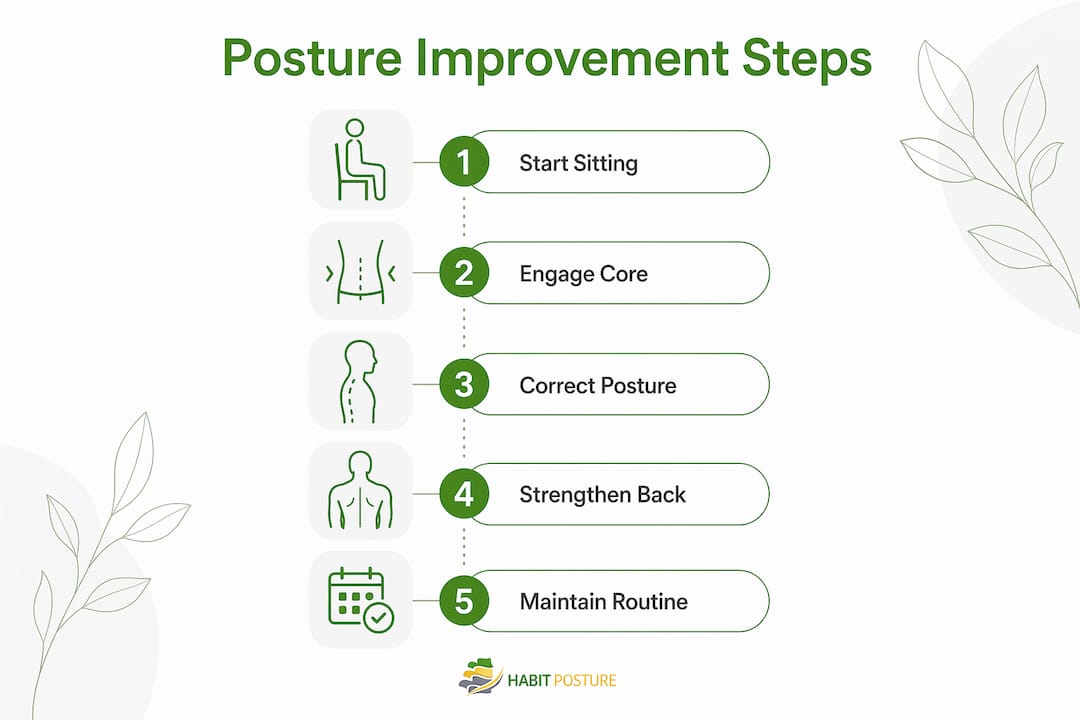
Here is how a complete posture routine looks when a balance cushion is integrated properly:
- Morning: Five minutes of chest and hip flexor stretching to reset overnight tightness.
- Workday: Balance cushion use for 1–2 hours, alternating with flat sitting and standing breaks every 45–60 minutes.
- Strength work: Two to three sessions per week targeting the posterior chain and deep core.
- Ergonomic setup: Monitor at eye level, keyboard at elbow height, and feet flat on the floor throughout the day.
| Routine element | Purpose |
|---|---|
| Balance cushion (active sitting) | Engages core and stabilizers, prevents static slouching |
| Posterior chain strengthening | Builds muscular endurance to hold upright alignment |
| Chest and hip flexor stretching | Releases forward-pulling tension from prolonged sitting |
| Ergonomic workstation setup | Removes structural causes of compensatory posture |
| Standing and movement breaks | Reduces cumulative spinal load and resets circulation |
Dr. Tara Salay’s “string analogy” captures the target well: imagine a string pulling gently from the crown of your head toward the ceiling. That image describes balanced neutral spine alignment, not the rigid overcorrection that many people attempt when they first start posture correction techniques. The goal is ease, not tension.
Who benefits most from using a balance cushion?
Balance cushion exercises and active sitting tools are not limited to office workers. The benefits of balance cushions extend across several distinct groups.
- Office workers and remote workers: People who sit for six or more hours daily are the primary beneficiaries. Balance cushions improve posture by encouraging subtle, continuous muscle recruitment that prevents the static loading contributing to back pain and spinal compression. For anyone grinding through spreadsheets or Zoom calls, this is the most direct application.
- Children and individuals with sensory or attention challenges: Children and individuals with sensory or attention challenges benefit from balance cushions’ ability to engage core muscles and enhance focus through active sitting. The sensory input from the unstable surface helps regulate attention in classroom settings.
- Yoga practitioners and fitness users: Balance pads for posture and stability training appear regularly in yoga and functional fitness contexts. Standing on a balance cushion during single-leg exercises increases proprioceptive demand and accelerates neuromuscular adaptation.
- Older adults in rehabilitation: Balance training is a core component of fall prevention programs. Seated balance cushion use provides a low-risk entry point for older adults rebuilding stability after injury or deconditioning.
The one consideration that applies to all groups is body weight. Standard cushions support up to 250 lbs, so users above that threshold should confirm the weight rating of their specific product before use.
Key Takeaways
A balance cushion improves posture by creating controlled instability that forces continuous core and spinal muscle engagement, making active sitting a practical daily habit for anyone who sits for extended periods.
| Point | Details |
|---|---|
| Active sitting mechanism | Controlled instability triggers proprioceptive feedback that keeps postural muscles engaged. |
| Progressive use protocol | Start with one hour daily and increase gradually to avoid muscle fatigue. |
| Inflation controls difficulty | Lower inflation increases postural challenge; higher inflation reduces sway for beginners. |
| Cushion plus routine | Pair balance cushion use with posterior chain strengthening and chest stretching for lasting results. |
| Broad user applicability | Office workers, children, older adults, and fitness users all benefit from regular cushion use. |
What I’ve learned about balance cushions after years of watching people use them wrong
Thomas here. I have seen a lot of people buy a balance cushion, sit on it for a full workday on day one, and then declare it useless because their back hurt more. That is not the cushion failing. That is the adaptation curve being ignored.
The most useful reframe I can offer is this: a balance cushion is a proprioceptive retraining tool, not a posture brace. It does not hold you in position. It teaches your nervous system to find position on its own. That process takes weeks, not days. People who stick with the one-hour-per-day protocol and pair it with ergonomic office habits consistently report better results than those who treat it like a passive fix.
The other pitfall I see regularly is neglecting the rest of the routine. A cushion cannot stretch your chest. It cannot strengthen your rhomboids. If you sit on it for an hour and then spend the other seven hours in a collapsed forward position, you are fighting yourself. The cushion is the starting point, not the whole answer.
My honest recommendation: start seated, start firm, and build slowly. Your body will tell you when it is ready for more challenge. Trust that signal.
— Thomas
Habitposture has the posture tools you actually need
If you have been folded into your chair since 9 AM and your neck is already complaining, you are in the right place.
Habitposture builds gear for people who live at their desks, not for people who visit a gym twice a year. From ergonomic support tools to practical guidance on building posture habits that stick, everything is designed for real workdays and real bodies. No lectures. No guilt. Just support that works while you work. Check out what Habitposture offers and find the right starting point for your posture routine today.
FAQ
What does a balance cushion actually do for posture?
A balance cushion creates controlled instability that forces your core and spinal stabilizing muscles to engage continuously during sitting. This prevents the static slouching that builds up over hours of desk work.
Can balance cushions improve posture for people with back pain?
Balance cushions can reduce back pain by preventing the static muscle loading that causes spinal compression, but they work best as part of a broader routine that includes strengthening and stretching. Consult a physical therapist if you have an existing spinal condition.
How long should you sit on a balance cushion each day?
Beginners should start with approximately one hour per day and increase duration gradually as stabilizing muscles adapt. Jumping to full-day use too quickly leads to muscle fatigue rather than posture improvement.
Does inflation level matter when using a balance cushion?
Inflation level directly controls the difficulty. Lower inflation increases postural sway and demands more core activation, while higher inflation reduces instability and suits beginners or those returning from injury.
Are balance cushions suitable for children?
Children, particularly those with sensory or attention challenges, benefit from balance cushions because the active sitting input engages core muscles and supports focus. Standard cushions are appropriate for children who fall within the weight capacity of the product.