The Role of Lumbar Curve Sitting on Your Back Health
The lumbar curve, known clinically as lumbar lordosis, is the natural inward bend of your lower spine that keeps your back healthy during long hours of sitting. When you lose that curve, your spine pays for it. The role of lumbar curve sitting goes far beyond comfort. It controls how load distributes across your discs, how hard your back muscles work, and whether you end the day feeling fine or folded. Research from Andersson et al. confirms that lumbar support restores this curve more effectively than simply reclining your backrest. Understanding why that matters changes how you set up your chair.
How does sitting affect the lumbar curve?
Unsupported sitting flattens your lumbar lordosis almost immediately. When you drop into a chair without back support, your pelvis rotates backward. That posterior pelvic tilt pulls your lower spine out of its natural inward curve and pushes it toward a flat or even outward position.
The consequences are measurable. Radiographic analysis by Andersson et al. shows that lumbar lordosis decreases significantly during unsupported sitting, and that lumbar support restores spinal alignment, reduces disc pressure, and lowers back muscle activity. Disc pressure is the force your intervertebral discs absorb. When that pressure rises, discs wear faster and pain signals increase.

Backrest inclination alone does not solve the problem. Leaning back in a chair without lumbar support still allows the pelvis to tilt and the lower curve to flatten. The lumbar support reduces rotational and translational movements in the spine that cause mechanical stress on the iliolumbar ligaments. That protection does not come from recline angle. It comes from direct support at the curve itself.
| Sitting Condition | Effect on Lumbar Curve | Disc Pressure | Muscle Activity |
|---|---|---|---|
| Unsupported sitting | Lordosis flattens significantly | Increases | Increases |
| Backrest recline only | Partial improvement | Moderate reduction | Moderate reduction |
| Lumbar support added | Lordosis restored | Decreases | Decreases |
Pro Tip: If you feel your lower back aching within 30 minutes of sitting, your pelvis has likely already tilted. Place a rolled towel at the small of your back before the ache starts, not after.
What are the real benefits of lumbar support?
Lumbar support works by preventing posterior pelvic rotation, which is the root cause of lordosis loss during sitting. Keeping the pelvis in a neutral position lets the lumbar spine maintain its natural curve without your muscles having to fight for it.
NHS guidance recommends using a supportive chair or a rolled towel placed in the small of the back to maintain lumbar support during sitting. The recommendation is not complicated. The positioning matters more than the device. Support placed too high hits the mid-back. Support placed too low misses the curve entirely.
Here is what proper lumbar support delivers:
- Restored lordosis. The curve returns to its natural position, reducing load on the discs.
- Lower muscle demand. Your lumbar erector spinae muscles do not have to work as hard to hold your spine upright.
- Reduced ligament stress. The iliolumbar ligaments stay within their safe range of motion.
- Improved comfort over time. Sitting for hours becomes less taxing when your spine is properly aligned.
- Better pelvic alignment. Neutral pelvis position is the foundation of good sitting posture throughout the whole spine.
Preventing posterior pelvic rotation to preserve lumbar lordosis matters more than simply sitting upright. You can sit perfectly straight and still lose your lumbar curve if your pelvis has tilted. That is the detail most people miss.
Pro Tip: Test your lumbar support position by sliding your hand between your lower back and the chair. You should feel gentle, even contact. If there is a gap, move the support up. If it pushes you forward uncomfortably, move it down.
How do lumbar muscles respond to sitting?
Your lumbar muscles do not relax when you sit. They actually work harder in some ways. Myotonometry measurements show that sitting increases lumbar erector spinae stiffness and muscle tone compared to standing, indicating higher mechanical demand on those muscles during seated posture.
Muscle stiffness is not the same as muscle strength. Stiffness here means the tissue becomes less pliable and more resistant to movement. That resistance builds up over time and contributes to the aching tightness you feel after hours at a desk.
Here is how the physiological sequence unfolds during a typical sitting session:
- You sit down. Your pelvis begins to rotate backward and your lumbar lordosis starts to flatten.
- Disc pressure rises. The flattened curve shifts load unevenly across the intervertebral discs.
- Muscles compensate. Your lumbar erector spinae increases tone to stabilize the spine against the new load.
- Stiffness accumulates. Over 20–30 minutes, muscle stiffness builds and spinal mobility decreases.
- Discomfort sets in. The combination of disc pressure and muscle tension produces the familiar low back ache.
Spinal loading and lumbar extensor stiffness change rapidly with sitting posture, which is why time management of sitting duration matters as much as chair setup. A good chair slows this process. It does not stop it indefinitely.
How to maintain lumbar curve with movement and exercise
Lumbar support is a starting point, not a complete solution. Lumbar support complements exercise and movement rather than replacing them. The two work together. One without the other leaves gaps.
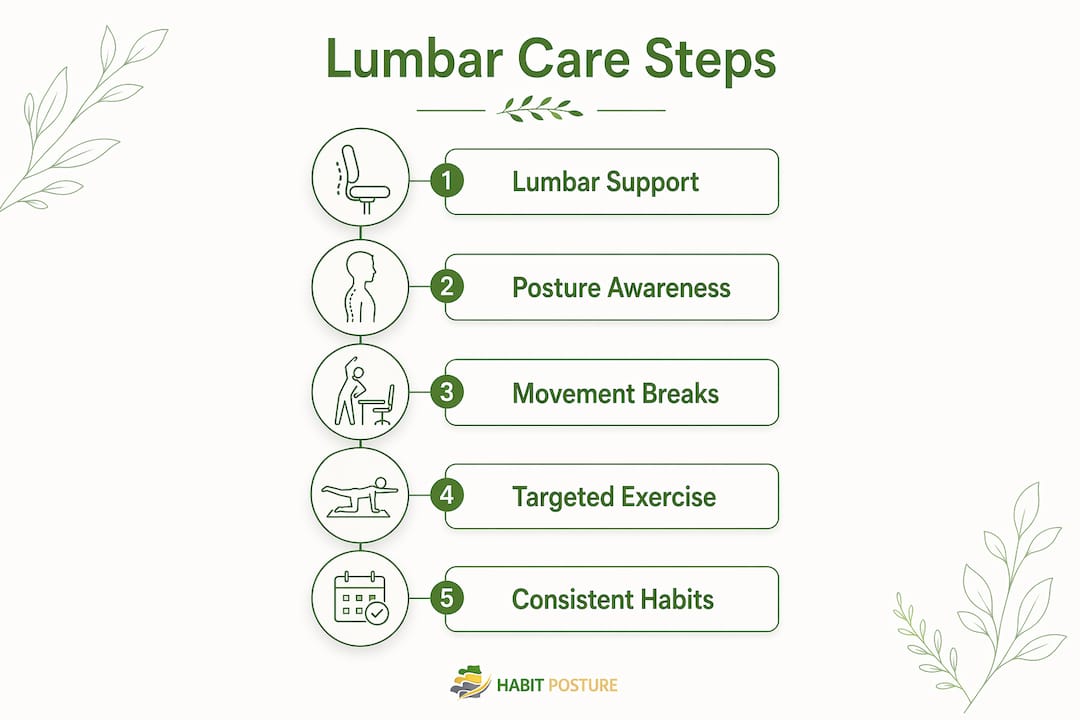
Movement breaks are the most underused tool in sitting ergonomics. NHS guidance recommends changing your sitting position every 20–30 minutes to manage low back pain. That recommendation is backed by the physiology. Muscle stiffness accumulates on a 20–30 minute timeline, so repositioning before that threshold resets the clock.
Here is a practical framework for combining support and movement:
- Set a 25-minute timer. Stand, walk, or stretch briefly before stiffness locks in.
- Vary your seated position. Shift your weight, adjust your recline, or lean slightly forward and back.
- Use a lumbar support consistently. An ergonomic office chair with built-in lumbar support removes the guesswork.
- Add targeted exercise. A randomized clinical trial published in PLOS One found that an 8-week corrective exercise program produced measurable improvements in lumbar lordosis angle and muscle activity in women with lower cross syndrome.
- Stay active outside of work hours. Most new low back pain improves within 6–8 weeks with activity and movement. Sitting well during the day and moving well outside of it is the full picture.
| Approach | Short-Term Benefit | Long-Term Benefit |
|---|---|---|
| Lumbar support only | Reduces disc pressure and muscle load | Limited without movement breaks |
| Movement breaks only | Resets muscle stiffness | Inconsistent without postural support |
| Support plus movement | Immediate comfort improvement | Sustained spinal health and pain reduction |
| Support plus exercise | Comfort and alignment | Improved lordosis angle and muscle function |
Movement breaks every 20–30 minutes combined with lumbar support optimize spinal health by reducing continuous mechanical demand. That combination is what the research consistently points to.
Key takeaways
Maintaining lumbar lordosis during sitting requires both consistent lumbar support and regular movement breaks, because neither strategy works as well alone.
| Point | Details |
|---|---|
| Lumbar curve flattens when sitting | Unsupported sitting causes posterior pelvic tilt, increasing disc pressure and muscle stiffness. |
| Lumbar support restores alignment | Support at the small of the back preserves lordosis better than backrest recline alone. |
| Muscles work harder seated | Lumbar erector spinae stiffness increases during sitting, building discomfort over time. |
| Movement breaks reset the load | Repositioning every 20–30 minutes prevents stiffness accumulation and reduces mechanical demand. |
| Exercise improves lordosis long-term | An 8-week corrective exercise program measurably improved lumbar curve angle in clinical trials. |
What i’ve learned about lumbar support that most articles get wrong
Most advice on sitting posture focuses on the arch. Arch your back. Sit up straight. Pull your shoulders back. That framing sends people in the wrong direction.
The real target is pelvic position, not spinal shape. When your pelvis is neutral, the lumbar curve follows naturally. When you force the arch without addressing the pelvis, you create compensatory tension in the mid-back and hips. I have seen this pattern repeatedly. People buy lumbar supports, crank them up to maximum, and end up with a different kind of pain.
Effective lumbar support gently maintains pelvic and lumbar alignment without forcing excessive arching or causing compensatory muscle strain. Gentle is the operative word. The support should feel like a hand resting at your lower back, not a fist pushing you forward.
The other mistake is treating lumbar support as a permanent fix. It is a management tool. Managing lumbar curve sitting is fundamentally a time and posture management issue. Support and positioning provide short-term relief, but long-term comfort requires micro-movements and dynamic posture changes to reduce muscle stiffness. The chair does its job for 20–30 minutes. After that, you need to move.
If you are shopping for a chair, look for adjustable lumbar depth and height, not just a fixed foam pad. The ability to position support precisely at your curve makes a real difference. A posture corrector worn during desk work can also reinforce pelvic alignment when your chair falls short. Neither replaces the habit of moving. Both make the habit easier to build.
— Thomas
How Habitposture supports your lumbar curve every day
If you spend 8 or more hours at a desk, your lumbar curve needs consistent support, not occasional attention. Habitposture builds gear specifically for that reality.
The Habitposture ergonomic chair collection includes chairs with adjustable lumbar support designed to maintain your natural lordosis through long work sessions. The high-back ergonomic chair pairs lumbar support with full back coverage for all-day comfort. For extra reinforcement, the adjustable lumbar back support brace helps retrain pelvic alignment whether you are at a desk, gaming, or on a call. Posture is a habit. Habitposture makes it easier to build a good one.
FAQ
What is the role of lumbar curve in sitting posture?
The lumbar curve, or lumbar lordosis, maintains proper load distribution across the spinal discs and reduces mechanical stress on the back muscles during sitting. Losing this curve through posterior pelvic tilt increases disc pressure and muscle stiffness.
Does lumbar support actually reduce back pain?
Yes. Radiographic analysis by Andersson et al. confirms that lumbar support restores lordosis, reduces disc pressure, and lowers back muscle activity compared to unsupported sitting.
How often should i change my sitting position?
NHS guidance recommends changing your sitting position every 20–30 minutes. That interval aligns with the rate at which lumbar muscle stiffness accumulates during seated posture.
Can exercise improve my lumbar curve?
Yes. An 8-week NASM-based corrective exercise program produced measurable improvements in lumbar lordosis angle and muscle activity in a randomized clinical trial, showing the curve responds to targeted training.
Is a rolled towel as effective as an ergonomic chair for lumbar support?
A rolled towel placed at the small of the back provides functional lumbar support and is recommended by NHS guidance for managing low back pain. An ergonomic chair with adjustable lumbar support offers more precise positioning and longer-term consistency.