Why Posture Worsens During Long Sessions at a Desk
Poor posture during long desk sessions is defined as the progressive breakdown of spinal alignment caused by sustained static positioning and forward trunk flexion. Your body does not collapse into a slump all at once. The process is gradual, mechanical, and entirely predictable. Approximately 65% of remote workers report chronic neck or back pain linked to hunched, static postures. That number reflects a workforce that sits for hours without understanding what is happening inside their spine and muscles. Understanding why posture worsens long sessions is the first step toward doing something about it.
Why does posture worsen during long sessions?
Posture deteriorates during extended sitting because the spine and surrounding muscles were not built for prolonged static loading. The clinical term for this process is postural fatigue syndrome, though most people simply call it “that 2 PM neck ache.” The core mechanism is straightforward: the longer you hold a forward-leaning position, the more your body’s structural support systems break down.
Lumbar intradiscal pressure increases by up to 270% during sustained forward trunk flexion. That means the discs between your vertebrae are absorbing far more force than they were designed to handle for hours at a time. Over a full workday, that load accumulates and accelerates spinal wear.
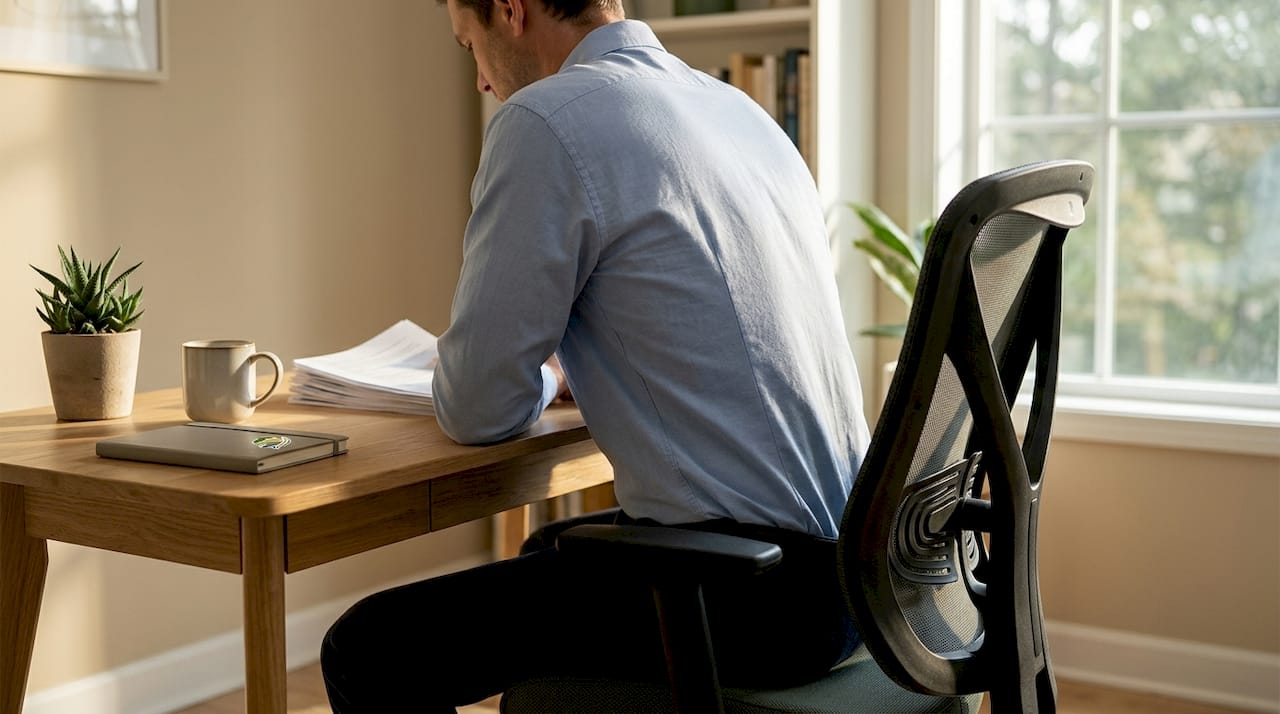
Muscle fatigue compounds the pressure problem. The deep stabilizing muscles of the spine, including the multifidus and erector spinae, are slow-twitch fibers built for endurance. But even they reach a fatigue threshold. Once they do, your body shifts the load to passive structures like ligaments and joint capsules, which are not designed to bear that weight. The result is the familiar ache that creeps in around midday and refuses to leave.
Pro Tip: Set a phone alarm for every 45 minutes. When it goes off, stand up, roll your shoulders back, and take five slow breaths. That single habit interrupts the fatigue cycle before it locks in.
What biomechanical changes happen to the spine and muscles?
The spine is a kinetic chain. A problem at one link creates compensations at every other link. Forward head posture leads to thoracic hyperkyphosis, which then alters scapular position, shoulder mechanics, and eventually pelvic tilt. This is why a stiff neck at 10 AM can become lower back pain by 3 PM.
Here is what happens mechanically during a long session:
- Anterior muscles shorten. The hip flexors, chest, and neck flexors tighten as they hold a contracted position for hours. Shortened anterior muscles pull the spine forward and down.
- Posterior muscles weaken. The upper back, glutes, and deep spinal stabilizers stop firing effectively. They are not needed when gravity and the chair are doing the work.
- The flexion-relaxation phenomenon kicks in. At extreme forward flexion, the spinal muscles actually switch off. Ligaments take over. Ligaments are not designed for sustained load and begin to stretch and strain.
- Compensatory shifts cascade downward. The pelvis tilts posteriorly, the lumbar curve flattens, and the thoracic spine rounds further. Each compensation creates a new stress point.
Within 4–8 weeks of sustained poor posture, rapid musculoskeletal fatigue and persistent pain develop due to progressive muscle inactivation. That timeline is shorter than most people expect. The damage is not sudden. It is slow, quiet, and cumulative.
How does poor posture affect more than just your back?
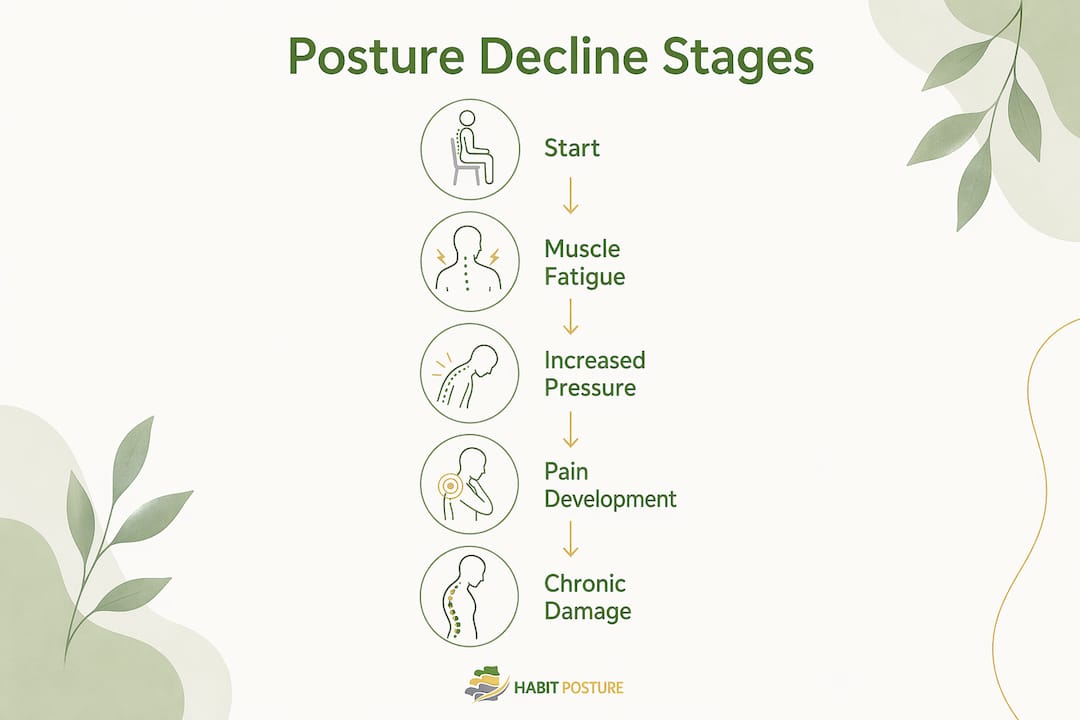
Posture is not merely a musculoskeletal issue. Fixing posture protects the nervous system and organ function, not just muscles and joints. When you slouch for hours, the effects ripple through multiple body systems in ways that most desk workers never connect to their sitting habits.
The systemic consequences follow a clear progression:
- Breathing becomes shallow. Slouching compresses the thoracic cavity and restricts diaphragmatic movement. Nearly 75% of people are unaware that poor posture directly reduces lung capacity. Less oxygen per breath means more fatigue, faster.
- Digestion slows. Abdominal compression from a rounded spine restricts the stomach and intestines. This contributes to acid reflux, bloating, and sluggish metabolism over the course of a long workday.
- Sleep quality drops. Poor posture elevates baseline muscle tone, keeping the body in a low-grade state of tension. That elevated tone makes it harder to fully relax at night, which means you wake up less recovered.
- The nervous system shifts into stress mode. Chronic slouching suppresses vagal tone, the parasympathetic signal that tells your body it is safe to rest and digest. The result is a subtle but persistent stress response that compounds over weeks.
Poor posture compresses the thoracic cavity, restricts the diaphragm, and reduces lung capacity. Over a full workday, that restriction means your brain and muscles receive less oxygen with every breath. The fatigue you feel at 4 PM is not just mental. It is physiological, and posture is a direct cause.
The bedroom office posture risks that remote workers face are especially significant here, because informal setups tend to encourage the worst slouching habits for the longest stretches.
What psychological and cognitive effects come from slouching all day?
The mind-body connection in posture is well documented and consistently underestimated. Upright posture correlates with faster mood recovery and more flexible cognitive processing compared to slouched positions. A study involving 269 participants confirmed that posture directly modulates emotional regulation and spontaneous thought patterns. That is not a minor finding.
Here is what sustained poor posture does to your mental performance:
- Oxygenation drops, and so does focus. A compressed thorax means less oxygen reaching the brain. Reduced cerebral oxygenation impairs attention, working memory, and decision speed.
- Pain creates cognitive noise. Back pain impairs focus and decision-making at work. When your body is sending distress signals, your brain splits its attention between the task and the discomfort.
- Cortisol rises. Sustained poor posture elevates sympathetic nervous system activity and cortisol production. Elevated cortisol impairs hippocampal glucose use and executive functioning, which means slower thinking and worse judgment.
- Mood suffers. Chronic slouching is associated with increased anxiety, lower energy, and greater susceptibility to depressive thinking. The body position reinforces the mental state.
The link between posture and workplace productivity is not motivational language. It is physiology. Your output quality at hour six of a session is directly shaped by how your body has been positioned for the previous five hours.
Why does staying still make posture worse, even with good alignment?
Static posture is the hidden villain in ergonomics. Most people assume that sitting correctly solves the problem. It does not. Maintaining even ideal posture statically for long hours causes muscle oxygen deprivation and reduced blood flow. The muscles responsible for holding you upright need circulation to keep working. Static contraction cuts off that supply.
The solution is movement variability, not positional perfection. Movement breaks every 30–60 minutes mitigate damage more effectively than sitting perfectly still for hours. Weight shifting, standing intervals, and brief walks all restore blood flow to fatigued muscles and reset the load on spinal discs.
Ergonomic adjustments are necessary but not sufficient on their own. A well-adjusted chair and monitor reduce the rate of postural breakdown. They do not eliminate it. The body needs to move. Static loading, even in a neutral spine position, eventually causes the same fatigue cascade that poor posture accelerates.
Pro Tip: Try the 30-20-2 rule: every 30 minutes, stand for 20 seconds and take 2 deep breaths. It takes less than a minute and resets your postural muscles without breaking your workflow.
How can you protect your posture during long desk sessions?
Understanding the mechanics behind postural breakdown makes the solutions obvious. The goal is not to achieve a perfect static position. The goal is to reduce cumulative load, maintain muscle activation, and build movement into your routine.
Practical strategies that work:
- Adjust your workstation first. Chair height, monitor placement, and keyboard position all affect how much forward flexion your body defaults to. Chair height directly affects posture and spinal loading throughout the day.
- Use posture support tools. Wearable posture trainers and lumbar supports provide tactile feedback that reminds your body to return to a better position. They work best as training tools, not permanent crutches.
- Strengthen the posterior chain. Core strengthening exercises can reduce back pain by up to 76%. Targeted work on the glutes, upper back, and deep spinal stabilizers builds the endurance needed to hold alignment longer.
- Practice diaphragmatic breathing. Slow, deep breaths expand the thoracic cavity and actively counteract the compression caused by slouching. Three minutes of deliberate breathing resets both posture and nervous system tone.
- Schedule standing breaks. Regular standing breaks improve posture and reduce discomfort during long work sessions more reliably than any single ergonomic product.
| Strategy | Primary benefit |
|---|---|
| Ergonomic chair and monitor setup | Reduces baseline spinal loading |
| Posture support wearables | Provides real-time alignment feedback |
| Core and back strengthening | Builds muscular endurance for sustained alignment |
| Movement breaks every 30–60 minutes | Restores blood flow and resets disc pressure |
| Diaphragmatic breathing practice | Counteracts thoracic compression and reduces cortisol |
Key Takeaways
Posture worsens during long sessions because static forward flexion increases spinal load, fatigues stabilizing muscles, and triggers a cascade of systemic effects that compound over hours.
| Point | Details |
|---|---|
| Spinal load increases fast | Intradiscal pressure rises by up to 270% during sustained forward flexion. |
| Muscle fatigue is the trigger | Stabilizing muscles tire and shift load to ligaments, causing pain and dysfunction. |
| Effects go beyond the back | Poor posture restricts breathing, slows digestion, and elevates cortisol. |
| Static “good” posture is not enough | Movement breaks every 30–60 minutes protect the body better than perfect stillness. |
| Cognition and mood are at stake | Slouching reduces oxygenation, raises cortisol, and impairs focus and emotional regulation. |
What I have learned from watching people sit for a living
People obsess over finding the perfect chair or the ideal monitor height. I understand the impulse. But after spending years looking at how desk workers actually move and hold themselves, the single biggest predictor of end-of-day pain is not setup quality. It is how rarely people move.
The workers who feel best at 5 PM are not the ones with the most expensive ergonomic equipment. They are the ones who get up, shift around, and treat their body as something that needs input throughout the day, not just at the start. Perfect posture held rigidly for eight hours causes almost as many problems as poor posture does. The spine needs variety.
The other thing I have noticed is that posture awareness tends to collapse under cognitive load. When a task gets hard, the body curls inward. Shoulders rise, the jaw tightens, and the whole frame compresses. Building a movement habit means making it automatic enough that it survives a stressful afternoon. That is the real challenge, and it is a behavioral one, not a biomechanical one.
My honest advice: stop chasing the perfect position and start building the habit of moving. Your body will tell you when it needs a reset. The trick is learning to listen before it starts shouting.
— Thomas
Habitposture gear built for the hours that hurt most
Long sessions take a real toll on your body. Habitposture builds posture support gear specifically for people who spend 8 or more hours at a screen, whether that is a gaming setup, a home office, or a corporate desk.
The gear works as a training system, not a medical device. Wear it during your session, feel your body recalibrate, and build the muscle memory that makes good alignment automatic. Pair it with the ergonomic guidance on the Habitposture blog for a complete approach to desk comfort. No lectures. No guilt. Just practical support that fits into the day you already have. Visit Habitposture to see the full range.
FAQ
Why does posture get worse as the day goes on?
Postural fatigue builds as stabilizing muscles tire and shift load to ligaments and passive structures. The longer you sit without moving, the faster this breakdown accelerates.
How does poor posture affect productivity?
Poor posture reduces oxygenation, elevates cortisol, and creates pain-based cognitive distraction. Studies show back pain directly impairs focus and decision-making at work.
Is good posture enough if I sit still all day?
No. Even correct posture held statically causes muscle oxygen deprivation and reduced blood flow. Movement breaks every 30–60 minutes protect the body more effectively than any fixed position.
What is the fastest way to reset posture during a long session?
Stand up, roll your shoulders back, and take three to five slow diaphragmatic breaths. This resets thoracic compression, restores blood flow, and reactivates the posterior stabilizing muscles.
How long does it take for poor posture to cause lasting damage?
Within 4–8 weeks of sustained poor posture, musculoskeletal fatigue and persistent pain develop due to progressive muscle inactivation and ligament strain.