Breathing Techniques for Desk Posture Improvement
Diaphragmatic breathing with a lengthened exhale is the most reliable breathing technique for desk posture improvement. It reactivates the diaphragm, reduces accessory muscle tension in your neck and shoulders, and creates natural spinal support from the inside out. Try this right now: take three slow belly breaths (inhale through your nose for 4 seconds, exhale for 6), then follow with four box breaths (4 counts in, hold 4, out 4, hold 4). That is your baseline micro-routine. Breathe gently throughout; stop if you feel dizzy, and check with your clinician before starting if you have a respiratory or cardiac condition.
- Diaphragmatic breathing restores trunk support and reduces neck tension
- Lengthened exhale activates the vagus nerve’s rest-and-digest response
- Nasal breathing as your default keeps breathing slower and more controlled
- Habitposture pairs this guidance with ergonomic support built for real desk life
Table of Contents
- Your 2-minute desk breathing routine you can do anywhere
- Step-by-step instructions for each seated breathing technique
- Desk stretches that pair directly with your breathwork
- Why does breathing actually change your posture?
- How to build this into your workday so it actually sticks
- When to stop, modify, or see a clinician
- Key Takeaways
- The part most posture guides skip
- Useful sources and further reading
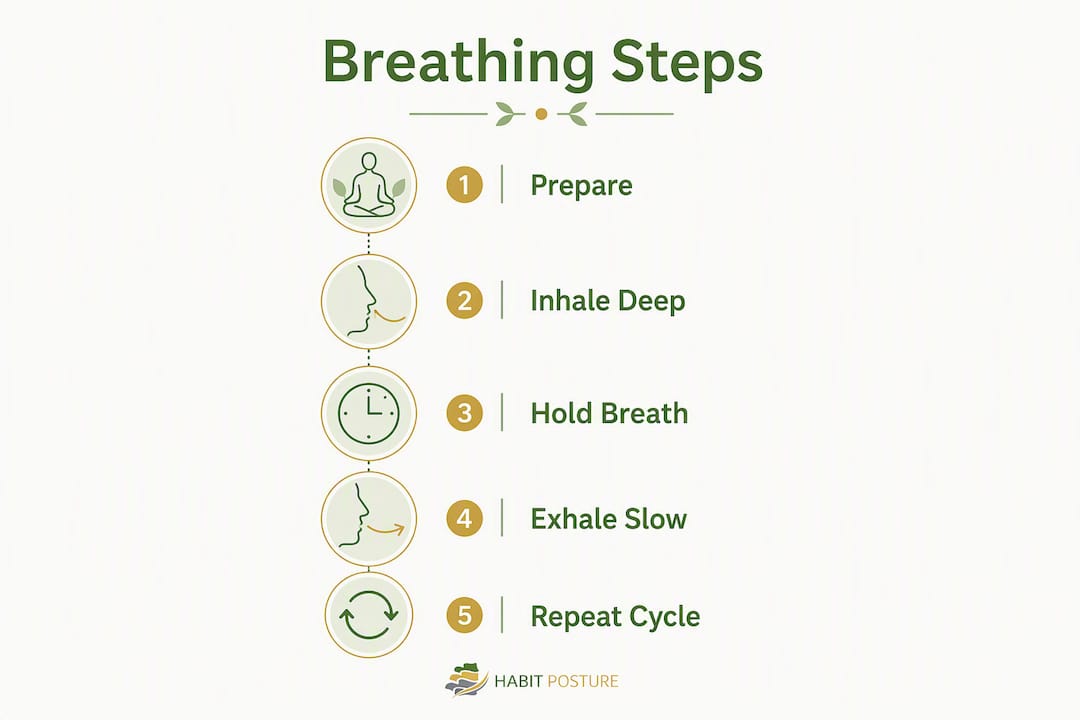
Your 2-minute desk breathing routine you can do anywhere
You do not need a quiet room or a yoga mat. This routine works at your desk, before a Zoom call, or during a quick break between tasks.
- Sit at the edge of your chair. Let your feet rest flat on the floor. For tips on maintaining good seated posture, see Piano Posture for Beginners Made Simple for helpful guidance on posture and breath coordination. This opens up diaphragmatic space and makes belly breathing noticeably easier than slumping back.
- Place one hand on your belly, one on your chest. Your belly hand should rise first on the inhale. If only your chest moves, you are using accessory muscles.
- Inhale through your nose for 4 seconds. Feel your abdomen expand outward. Keep your shoulders relaxed and down.
- Hold gently for 2 seconds. No strain. Just a brief pause.
- Exhale slowly through your nose (or softly pursed lips) for 6 seconds. Let your belly fall. This extended exhale is where the parasympathetic reset actually happens.
- Repeat 4–6 times. Two minutes total. Done.
Use this at the start of your day, before any meeting, and as an hourly micro-reset. A Pomodoro cadence (every 25 minutes) works well, but every 60–90 minutes is a realistic minimum for most desk workers.
Pro Tip: To stay discreet in meetings, keep the exhale nasal-only with a barely perceptible softening of the lips. No one will notice, and you will still get the full calming benefit.
Step-by-step instructions for each seated breathing technique
Each technique below has a specific job. Mix and match them based on what your workday throws at you.

Diaphragmatic breathing (belly breathing)
Purpose: Restore baseline diaphragm function and reduce shoulder and neck tension.
The American Lung Association recommends daily practice to retrain breathing mechanics and reduce reliance on accessory muscles.
- Sit upright or at the edge of your chair
- Place one hand on your chest, one on your belly
- Inhale slowly through your nose; belly rises, chest stays mostly still
- Exhale fully; belly falls
- Practice 5–10 minutes in the morning and during hourly resets
Modification: If you feel lightheaded, shorten the exhale to 4 seconds and breathe at a comfortable pace rather than forcing depth.
4-7-8 breathing
Purpose: Acute stress relief before a high-stakes meeting or after a tense call.
- Inhale through your nose for 4 counts
- Hold for 7 counts
- Exhale through pursed lips for 8 counts
- Repeat 3–4 cycles
Modification: The 7-count hold can feel intense. Drop it to a 4-count hold if you are new to breath retention.
Box breathing (paced breathing)
Purpose: Mental reset and focus recovery during mid-afternoon slumps.
- Inhale for 4 counts
- Hold for 4 counts
- Exhale for 4 counts
- Hold for 4 counts
- Repeat 4–6 cycles
This equal-ratio pattern is used in clinical and performance settings to balance arousal and calm. It pairs well with the start of a deep-focus work block.
Physiological sigh
Purpose: Immediate tension release after extended screen time.
Research describes the physiological sigh as an effective acute reset that re-expands the alveoli and reduces shallow-breathing tension fast.
- Take a full nasal inhale
- At the top, sneak in a short second sniff to fully inflate the lungs
- Release with a long, slow exhale through your mouth or nose
- One to three repetitions is enough
Pursed-lip breathing
Purpose: Slow your breathing rate and improve ventilation efficiency, especially after stress.
- Relax your shoulders and jaw
- Inhale through your nose for 2 counts
- Purse your lips as if blowing out a candle
- Exhale slowly for 4 counts
- Repeat 5–10 times
Nasal breathing as your default: Switch from mouth to nasal breathing by simply closing your mouth and breathing through your nose during routine tasks. It naturally slows your rate and filters the air. If nasal congestion makes this hard, try a brief nasal rinse or consult your doctor.
Desk stretches that pair directly with your breathwork
Breathing changes posture from the inside; these moves reinforce it from the outside. Keep each one brief. Small, frequent corrections beat a single long stretching session every time.
- Chin tuck: Sit tall, gently draw your chin straight back (not down). Exhale as you tuck. Hold 3 seconds. Releases the suboccipital muscles that tighten during forward-head posture. Repeat 5 times.
- Shoulder rolls: Roll shoulders up, back, and down in a slow circle. Inhale on the up, exhale on the back and down. Three rolls forward, three back. Pairs well with the start of your 2-minute routine.
- Seated chest opener: Interlace fingers behind your head, gently open elbows wide. Inhale deeply to expand the chest. Hold 2–3 seconds, then exhale and release. Counteracts the forward-rounding that builds up during typing.
- Seated edge posture reset: Shift to the front third of your chair, feet flat. Take two belly breaths here before returning to your normal seat position. This alone can reset your spinal alignment mid-meeting.
- Thoracic extension over chair back: Sit near the back of a high-back chair, place hands behind your head, and gently arch your upper back over the chair’s top edge. Inhale to extend, exhale to return. Two to three reps.
- Neck side stretch: Drop your right ear toward your right shoulder. Exhale slowly and hold for 3–4 breath cycles. Switch sides. Targets the levator scapulae, which tightens from mouse and keyboard use.
- Seated spinal twist: Sit tall, place your right hand on your left knee. Inhale to lengthen your spine, exhale to rotate gently left. Hold for two breaths, then switch. Mobilizes the thoracic spine without leaving your chair.
- Wrist and forearm release: Extend one arm, gently pull fingers back with the other hand. Breathe normally. Holds tension from typing that travels up into the shoulder and neck.
Pair these with your hourly micro-reset or right before a long phone call. The posture improvement guide for office workers from Habitposture covers more no-equipment moves that fit the same format.
Why does breathing actually change your posture?
The diaphragm is not just a breathing muscle. It is a core stabilizer. When it contracts fully on each inhale, it increases intra-abdominal pressure and supports the lumbar spine from within. Slumped sitting compresses the diaphragm and reduces inspiratory volume by roughly 25–30% compared with standing. Your body compensates by recruiting the scalenes, sternocleidomastoid, and upper trapezius muscles instead. Those are the muscles that ache by 2 PM.
Slow breathing, defined as 6–10 breaths per minute versus the resting adult norm of 12–18 breaths per minute, activates the vagal rest-and-digest response. That shift reduces muscle tone in the neck and shoulders and lowers blood pressure. The extended exhale drives most of these effects.
Clinical research published in PMC confirms that breathing-focused physiotherapy can significantly improve spinal mobility and posture measures compared with control groups. Breathing retraining also reduces chronic tension and mobility limits in both athletic and rehabilitation settings, as CNN Health reported in 2025.
| Mechanism | What happens at your desk | Why it matters |
|---|---|---|
| Diaphragm compression | Slumped posture reduces inspiratory volume by roughly 25–30% | Accessory muscles overwork, causing neck/shoulder pain |
| Slow breathing (6–10 bpm) | Activates vagus nerve, lowers resting muscle tone | Shoulders drop, spinal support improves |
| Extended exhale | Drives parasympathetic activation | Reduces tension faster than inhale-focused breathing |
| Diaphragm as stabilizer | Full diaphragm contraction supports lumbar spine | Natural spinal support without “sitting up straight” |
Stat to know: Slumped sitting reduces your breathing capacity by roughly 25–30%. That is not a minor inconvenience. It is the reason your neck tightens and your focus drops by mid-afternoon.
How to build this into your workday so it actually sticks
Short practices done consistently beat long sessions done occasionally. The American Lung Association recommends practicing new breathing patterns during calm moments so they become automatic before you need them under stress.
Recommended schedule:
- Morning (5–10 minutes): Diaphragmatic breathing reset before you open your first app. Sets your baseline for the day.
- Hourly micro-reset (1–2 minutes): One physiological sigh, four box breaths, two shoulder rolls. Takes 90 seconds.
- Pre-meeting (30 seconds): Three belly breaths at the edge of your chair. Nasal only.
- End of day: A short horizontal session lying flat, if you have privacy, produces a deeper muscle-tone reset than seated work alone.
Behavioral cues that work:
- Tie your micro-reset to your Pomodoro timer or calendar alerts
- Use a phone call ending as a trigger: one physiological sigh before you pick up the next task
- Set a recurring 60-minute reminder labeled “breathe + posture check”
Progress indicators to watch for:
- Easier nasal breathing within 1–2 weeks of daily practice
- Reduced neck tension by week 3–4
- Noticeably taller seated posture without conscious effort by week 4–6
4-week habit checklist (copy into your calendar or a habit app):
- [ ] Morning 5-minute belly breathing session
- [ ] Hourly micro-reset (set phone alarm)
- [ ] Nasal breathing default during routine tasks
- [ ] Pre-meeting 3-breath reset
- [ ] Weekly posture check: does your neck feel less tight?
For a broader workplace wellness posture plan, Habitposture’s desk-worker guide covers how to layer ergonomic habits alongside breathwork.
When to stop, modify, or see a clinician
Most people can practice these techniques safely. A few situations call for caution.
- Lightheadedness or dizziness: Reduce your exhale length, breathe at a gentler pace, and stop if symptoms persist. This usually means you are breathing too deeply or too fast.
- Tingling in hands or face: A sign of mild hyperventilation. Slow down, breathe normally for a minute, and restart at a lower intensity.
- COPD, asthma, or other respiratory conditions: Pursed-lip breathing and diaphragmatic breathing are used in pulmonary rehab, but get clearance from your clinician before starting a new routine.
- Cardiac conditions: Slow breathing can lower blood pressure. If you are on blood pressure medication or have a heart condition, consult your doctor before practicing techniques with breath holds.
- Vertigo: Avoid breath retention entirely. Stick to gentle nasal breathing with a natural exhale.
- Persistent neck, shoulder, or back pain: Breathwork can help, but pain that does not improve after 4–6 weeks of consistent practice warrants evaluation by a physical therapist or your primary care provider.
If you experience chest pain, palpitations, or shortness of breath during practice, stop immediately and contact a healthcare provider. This article is general wellness information, not medical advice. Confirm any approach with your clinician if you have an existing health condition.
Key Takeaways
Diaphragmatic breathing with a lengthened exhale is the single most effective breathing technique for desk posture improvement, and consistent daily practice produces noticeable changes within 4–6 weeks.
| Point | Details |
|---|---|
| Start with diaphragmatic breathing | Belly breathing restores diaphragm function and reduces neck and shoulder tension from day one. |
| Extend your exhale | A 6-second exhale (vs. 4-second inhale) drives parasympathetic activation and spinal support. |
| Slumped posture cuts breathing capacity | Slouching reduces inspiratory volume by roughly 25–30%, which forces accessory muscles to overwork. |
| Practice during calm moments | Building the habit during low-stress windows makes it automatic when pressure hits. |
| Pair breathwork with posture moves | Chin tucks, shoulder rolls, and seated chest openers translate breath changes into lasting spinal support. |
The part most posture guides skip
There is a tendency in posture advice to treat breathing as a bonus add-on, something you do after you have already fixed your chair height and monitor angle. The research tells a different story. Breathing is the mechanism. Fix the breath pattern first, and the posture often follows without you having to think about it.
What I find most underestimated is the exhale. Every breathing guide leads with the inhale: breathe deeper, breathe bigger. But the exhale is where the real shift happens. A longer exhale is what activates the vagus nerve, drops your shoulders, and restores the diaphragm’s role as a spinal stabilizer. You do not need a longer inhale. You need a slower, fuller exhale.
The other thing worth saying plainly: no breathing technique works in isolation if your chair is fighting you. Breathwork opens the door; ergonomic support keeps it open. A well-fitted posture corrector or a high-back ergonomic chair gives your body a structural reference point so the habits you are building have somewhere to land. Habitposture’s ergonomic posture supports are designed for exactly this: real desk life, not a clinical setting.
Start with the 2-minute routine. Do it today. The rest builds from there.
Useful sources and further reading
The claims in this article draw from the following authoritative sources:
- Breathing Exercises for Better Lung Health — American Lung Association: technique instructions, diaphragmatic breathing steps, and practice-timing guidance
- Breathing Techniques — Johns Hopkins Medicine: step-by-step diaphragmatic breathing template with hand-on-belly feedback
- Breathing exercises to lower your blood pressure — Harvard Health: slow breathing norms (6–10 bpm vs. 12–18 bpm resting) and blood pressure effects
- Effects of Classical Breathing Exercises on Posture, Spinal Mobility — PMC: clinical evidence that breathing-focused physiotherapy improves posture and spinal mobility
- Every breath you take affects how you move — CNN Health: movement specialists on breathing mechanics, chronic tension, and mobility
- Is it too late to save your posture? — Harvard Health: posture improvement through habit change and muscle strengthening
- Guide to Good Posture — MedlinePlus: general posture guidance and core-strengthening recommendations