What Poor Posture Really Costs Employers in 2026
How much does poor posture actually cost your business?
The financial burden of poor posture on employers is larger than most budget meetings account for. Musculoskeletal disorders (MSDs) cost American workplaces roughly $20 billion per year in direct expenses alone, and indirect costs, including lost productivity, retraining, and product defects, can run up to five times higher. That means the real tab for ignoring workplace posture could reach $100 billion when you factor in everything that never shows up on a workers’ compensation claim.
Here is where those costs land:
- Direct medical costs: Treatment for back pain, neck strain, and repetitive stress injuries
- Workers’ compensation claims: MSDs account for one-third of all workers’ compensation costs in the U.S.
- Lost productivity: Employees in pain work slower, make more errors, and disengage
- Absenteeism: Injured workers miss days, and their teams absorb the slack
- Presenteeism: Workers show up but operate at a fraction of their capacity
- Turnover costs: Chronic discomfort can lead some employees to leave, causing rehiring and retraining expenses
The scale: Nearly 400,000 MSD injuries occur in American workplaces every year. That is not a rounding error. It is a structural problem with a structural solution.
The good news is that ergonomic interventions are among the highest-return investments available to employers, with benefit-to-cost ratios ranging from 2:1 to 10:1. The cost of poor posture for employers is real, but so is the payoff for fixing it.
What poor posture does to your employees physically
Poor posture is not just slouching. It is any sustained position that places the spine, joints, or soft tissue outside their neutral alignment, and office environments create the perfect conditions for it. Rounded shoulders from screen work, a forward head position from leaning toward a monitor, and a collapsed lower back from unsupported sitting are the most common patterns.

The physical consequences accumulate quietly. Awkward and static postures increase compressive forces on intervertebral discs, restrict local blood circulation, and cause muscle tension to build without adequate recovery. Over time, what starts as afternoon stiffness progresses into chronic musculoskeletal conditions that reduce mobility and strength.
The body regions most affected in office settings include:
- Lower back and lumbar spine: The most common site of MSD complaints, worsened by prolonged sitting without lumbar support
- Neck and upper back: Forward head posture adds load to cervical vertebrae and strains the trapezius
- Shoulders: Rounded positioning shortens the pectoral muscles and compresses the shoulder joint
- Wrists and hands: Poor keyboard and mouse placement drives repetitive strain injuries
- Knees and hips: Incorrect seat height creates joint compression and reduces circulation
Prolonged computer use combined with working in awkward postures is one of the strongest predictors of MSD development among office workers. The physical damage is gradual, which is exactly why it gets ignored until it becomes expensive. You can learn more about how these musculoskeletal effects develop in desk workers and what early warning signs look like.
How poor posture drains productivity and employee well-being
The financial impact of poor posture at work extends well beyond medical bills. Workers experiencing persistent discomfort suffer reduced concentration, increased irritability, and a slower work pace. None of that shows up in a single line item, but all of it erodes output.

Presenteeism is the hidden engine of this cost. An employee who comes to work with chronic back pain is physically present but mentally compromised. The UC Berkeley Center for Occupational and Environmental Health frames this precisely: economic loss from poor ergonomics is best understood as opportunity cost, the output that could have been produced if workers were not fatigued and uncomfortable.
The financial and mental consequences break down like this:
- Presenteeism: Workers in pain produce less, make more errors, and require more supervision
- Absenteeism: Chronic MSD conditions lead to sick days, medical appointments, and extended leave
- Mental fatigue: Physical discomfort accelerates cognitive exhaustion, reducing decision quality
- Error rates: Fatigued workers in precision tasks generate more defects, warranty claims, and rework
- Morale decline: Persistent discomfort lowers job satisfaction and increases turnover intent
The hidden multiplier: Indirect costs from poor ergonomics, including replacing workers, retraining, and productivity losses, can be 0.5 to 20 times higher than the direct medical and compensation costs.
Posture-related productivity loss is particularly difficult to quantify, which is why it tends to be underestimated. But the impact on workplace productivity is measurable when you track output quality, error rates, and absenteeism together rather than in isolation.
Ergonomic strategies that actually prevent posture-related costs
Prevention is where the math gets compelling. Employers who invest in ergonomic design before injuries occur spend far less than those who react after the fact. The most effective interventions are not expensive; they are consistent.
Adjustable sit-stand desks are one of the most evidence-backed tools available. Research shows that employees who can freely alternate between sitting and standing are approximately 6.5% more productive than those restricted to sitting, with the gains most pronounced during late morning and mid-afternoon focus periods. That productivity lift compounds across a full workforce.
Practical prevention strategies include:
- Workstation ergonomic assessments: Evaluate monitor height, chair adjustment, keyboard placement, and lighting for every desk-based employee
- Sit-stand desk access: Provide height-adjustable workstations, especially for employees working more than six hours at a desk
- Movement break policies: Schedule brief standing or stretching breaks every 30 minutes to interrupt static posture
- Ergonomic training programs: Teach employees how to set up their own workstations correctly
- Chair and accessory upgrades: Lumbar support, monitor arms, and footrests address the most common postural risk factors at low cost
- Workload design: Rotate tasks to reduce repetitive motion and sustained awkward positions
For practical setup guidance, the ergonomic workstation principles that apply to open office environments translate directly into lower injury risk and fewer compensation claims.
Pro Tip: Brief movement breaks are effective even when ergonomic equipment is already in place. Static posture is a primary driver of musculoskeletal risk regardless of chair quality. One to two minutes of standing or stretching every 30 minutes reduces ligament, muscle, and tendon strain in ways that no chair alone can replicate.
What business leaders can do right now to reduce posture-related expenses
Translating awareness into policy is where most organizations stall. The gap between knowing poor posture is costly and actually changing how the workplace operates is where the real expense lives. Closing that gap requires specific commitments, not general intentions.
Start with a posture-friendly schedule. Build movement breaks into the workday as a formal policy, not a suggestion. Employees who feel permission to stand, stretch, or walk briefly during the day are more likely to do it consistently. Pair that with standing break guidance so employees understand the physical rationale, not just the rule.
Recommended steps for business leaders:
- Conduct a workplace ergonomics audit: Identify the highest-risk workstations and prioritize upgrades based on injury history and job demands
- Invest in ergonomic training: A one-time training session on posture and workstation setup pays dividends for years
- Establish regular posture assessments: Annual or semi-annual reviews catch problems before they become claims
- Create a reporting culture: Employees should feel comfortable flagging discomfort early, before it becomes a formal injury
- Track MSD-related metrics: Monitor absenteeism rates, workers’ compensation claims, and productivity data together to measure the impact of interventions
- Partner with occupational health professionals: An ergonomics specialist can identify risks that internal teams miss
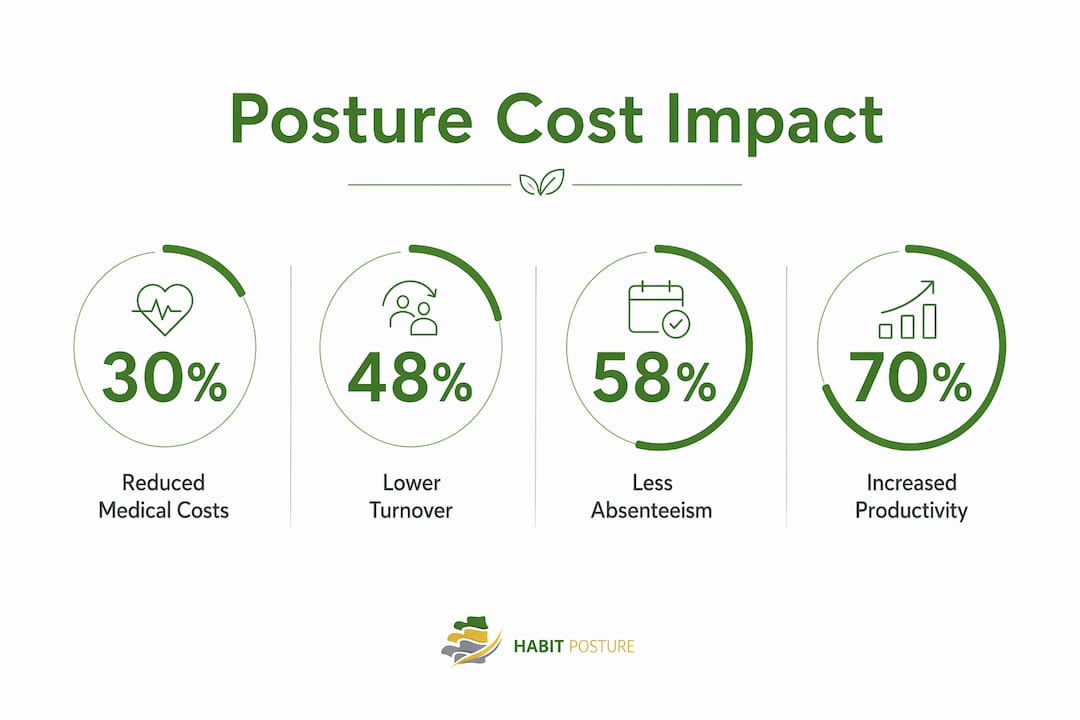
A proactive ergonomics program has been shown to reduce employee turnover by 48% and absenteeism by 58% in documented case studies. Those are not marginal improvements. They represent a fundamental shift in how much your workforce costs to maintain.
What the research says about the economics of ergonomic investment
The financial case for ergonomic intervention is not theoretical. Researchers at the UC Berkeley COEH have documented that poor working conditions generate quality errors, product defects, and warranty claims that extend well beyond any single injury claim. Fatigue from physically demanding or poorly designed tasks accumulates into chronic injury and brand erosion.
Stephen McNierney, an ergonomics expert cited in the NC State Ergonomics Center’s business case analysis, puts it plainly: high workers’ compensation costs from MSDs are not an inevitable cost of doing business. They reflect a failure to implement preventable structural changes.
Key economic findings from the research:
- Benefit-to-cost ratios of 2:1 to 10:1 for ergonomic interventions, with payback periods often under four months
- Indirect costs up to 20 times higher than direct costs when you include retraining, overtime, quality losses, and turnover
- 68% reduction in workers’ compensation costs in documented case studies following proactive ergonomics programs
- 39% reduction in cost per claim and a 43% decrease in labor costs in the same studies
- American Express Financial Advisors lowered ergonomics-related costs by 80% after implementing a structured program
- Siemens VDO Automotive reduced strain injuries from 43% to zero and saved 20,000 hours per year previously lost to pain and medical visits
The return: Every dollar invested in ergonomic improvements can return $2 to $10 in benefits, making it one of the highest-yield investments in workplace health.
The costs of bad workplace ergonomics are not fixed. They respond directly to intentional design choices, and the organizations that treat ergonomics as infrastructure rather than a perk consistently outperform those that treat it as optional.
Long-term healthcare and disability costs tied to poor posture
The long-term financial exposure from untreated posture problems extends far beyond the initial injury. Musculoskeletal disorders that go unaddressed progress into chronic conditions requiring ongoing medical management, physical therapy, and in serious cases, surgical intervention. Each of those stages carries its own cost, and the employer often bears a significant share through insurance premiums and workers’ compensation.
Disability claims represent the most expensive endpoint. An employee who transitions from a treatable MSD to a long-term disability claim removes productive capacity from your organization while generating sustained administrative and insurance costs. Work-related MSDs account for roughly 40% of total occupational compensation costs in developed countries, a figure that reflects years of accumulated, preventable exposure.
The trajectory matters. A sprain caught early costs far less than one that becomes a chronic condition. According to OSHA’s Safety Pays Cost Calculator, a single workplace sprain averages $28,866 in direct costs and $31,752 in indirect costs. A strain runs $33,528 in direct costs and $36,880 in indirect costs. Multiply those figures across a workforce where posture problems are widespread, and the long-term liability becomes a material business risk, not a wellness footnote.
Employers who invest in posture habits early reduce the probability of reaching that expensive endpoint. Prevention at the habit level is cheaper than treatment at the disability level, by a wide margin.
Legal and compliance risks employers face from poor workplace ergonomics
Poor workplace ergonomics creates legal exposure that many employers do not fully account for until a claim arrives. OSHA’s General Duty Clause requires employers to provide a workplace free from recognized hazards that are causing or likely to cause serious physical harm. Ergonomic hazards, including sustained awkward postures, repetitive motion, and poorly designed workstations, fall squarely within that mandate.
OSHA does not currently enforce a standalone ergonomics standard, but that does not eliminate liability. Employers can still receive citations under the General Duty Clause when ergonomic hazards are documented and unaddressed. State-level regulations add another layer. California, Washington, and several other states maintain specific ergonomics requirements for certain industries, and non-compliance carries financial penalties.
Beyond regulatory risk, civil liability is a real exposure. Employees who develop chronic MSDs from workplace conditions may pursue legal action, particularly when they can demonstrate that the employer was aware of the hazard and failed to act. The documentation trail matters. An employer who conducted no ergonomic assessments, provided no training, and ignored early complaints is in a far weaker legal position than one with a documented prevention program.
Workers’ compensation costs also interact with legal risk in a compounding way. High claim rates can trigger premium increases, audits, and in some jurisdictions, enhanced scrutiny from state labor agencies. The employer liability associated with MSDs is not just about individual claims. It shapes your organization’s relationship with insurers, regulators, and your own workforce. A documented ergonomics program is both a financial investment and a legal defense.
Key Takeaways
Poor posture costs employers far more than medical bills, with indirect losses from productivity, turnover, and quality failures often dwarfing direct compensation costs by a factor of up to 20.
| Point | Details |
|---|---|
| Direct MSD costs are $20B annually | American workplaces spend roughly $20 billion per year on direct musculoskeletal disorder costs, with indirect costs up to five times higher. |
| Ergonomic ROI is 2:1 to 10:1 | Every dollar invested in ergonomic interventions returns $2 to $10 in measurable benefits, with payback periods often under four months. |
| Sit-stand desks boost productivity 6.5% | Employees who freely alternate sitting and standing are approximately 6.5% more productive, especially during late morning and mid-afternoon. |
| Proactive programs cut turnover by 48% | Documented case studies show a 48% reduction in employee turnover and a 58% reduction in absenteeism after ergonomics programs. |
| Legal exposure is real without a program | OSHA’s General Duty Clause covers ergonomic hazards; employers without documented prevention programs face greater regulatory and civil liability. |