Posture Correction Methods Compared for Screen Users
For people spending 8+ hours at a screen, the most effective approach combines an active biofeedback wearable with targeted posterior-chain strengthening and basic workstation ergonomics. A systematic review of randomized controlled trials confirms that multimodal programs outperform any single method for reducing neck pain and disability. You’ll likely notice better body awareness within two to four weeks. Lasting structural change takes longer, typically several weeks to a few months of consistent effort.
Quick stat: A meta-analysis found chronic strengthening produced large effect sizes (d ≈ 0.83–1.04) for thoracic and cervical posture, while chronic stretching showed no meaningful postural change.
Table of Contents
- How do the main posture correction methods compare?
- Why strengthening plus biofeedback works better than stretching alone
- How to choose the right method when you work 8+ hours at a screen
- How to use a wearable successfully during long screen days
- Risks, contraindications, and when to see a clinician
- Your recommended 8-week plan and where Habitposture fits
- Key Takeaways
- The honest truth about posture and screens
- Habitposture supports your posture habit from day one
- Useful sources and further reading
How do the main posture correction methods compare?
Not all posture correction techniques are built for the same problem. Here’s how each category stacks up for desk-based screen users.
Active biofeedback wearables use sensors (often inertial measurement units placed at thoracic landmarks like T1 or T12) to detect slouching and send a gentle vibration cue. They train awareness without doing the work for you. Short-term gains in alignment and body awareness are well-documented, though wearable research notes that heterogeneity and short follow-ups limit definitive clinical recommendations.
Passive support braces pull your shoulders back mechanically. They can relieve discomfort quickly, but the stabilizing work is done by the brace, not your muscles. Overuse risks muscle weakening, and they do nothing to retrain motor patterns. Clinicians recommend using them only temporarily alongside active strengthening.
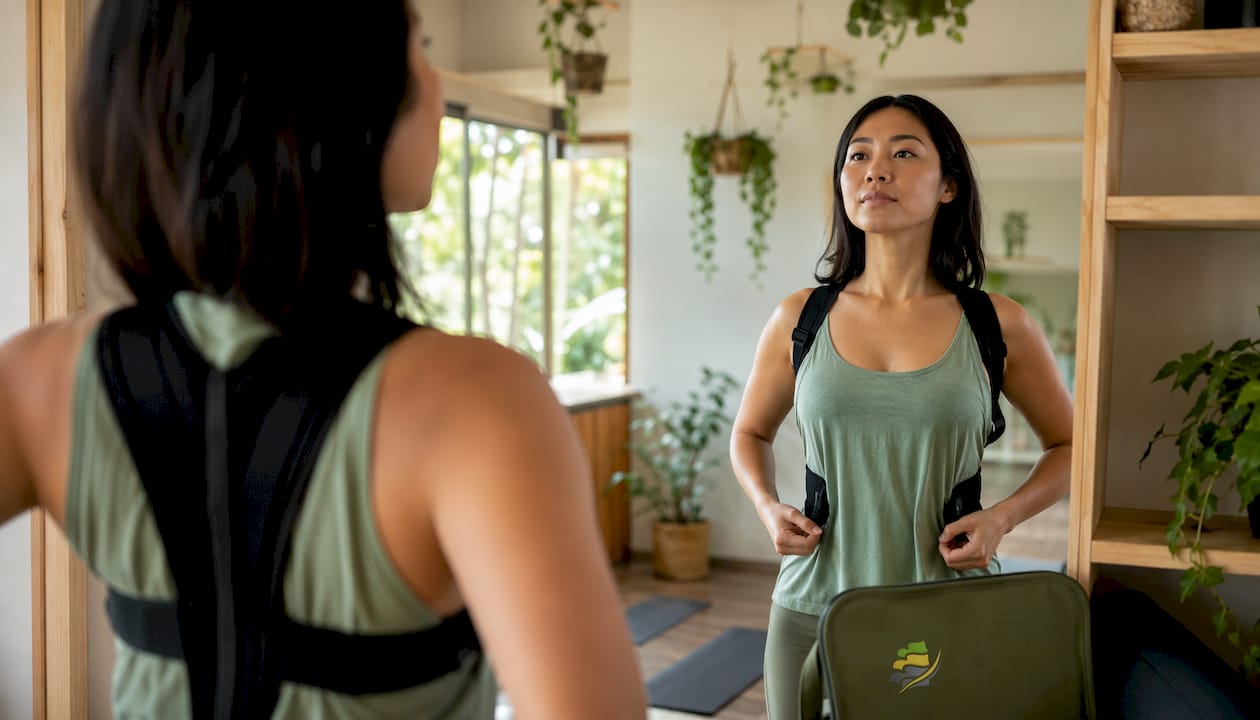
Targeted exercise programs address the root cause: tight anterior muscles and weak posterior antagonists. A 6-week RCT in adolescents with hyperkyphosis showed significant improvements in kyphosis angle, shoulder position, and forward head posture for exercise groups versus controls. An 8-week program run three times per week significantly reduced shoulder, mid-back, and low-back pain scores.
Workstation ergonomics won’t fix muscle imbalance on their own, but a poorly set-up desk actively fights every other method you try. Monitor height, chair support, and keyboard placement all affect how much load your spine carries across a long day.
Professional and clinical care (physical therapy, chiropractic, occupational therapy) is the right call when pain is persistent, neurological symptoms appear, or self-directed progress stalls after six to eight weeks.
| Method | Effectiveness for lasting change | Approach | Best use-case | Key risk | Ease/comfort | Cost and time | Evidence level |
|---|---|---|---|---|---|---|---|
| Active biofeedback wearable | Moderate (short-term gains confirmed) | Active (motor learning) | Desk workers, gamers, remote workers | Over-reliance if not paired with exercise | High | Low–moderate / daily | Preliminary; heterogeneous RCTs |
| Passive support brace | Low for lasting change | Passive (mechanical) | Acute relief, short-term use only | Muscle weakening with overuse | Moderate | Low / minimal | Limited long-term evidence |
| Targeted strengthening program | High | Training (active) | Anyone with muscle imbalance or pain | Low if progressed correctly | Moderate | Low–moderate / 3×/week | Strong (RCTs, meta-analyses) |
| Workstation ergonomics | Moderate (reduces load, supports other methods) | Environmental | All desk workers | None significant | High | Low / one-time setup | Strong (clinical consensus) |
| Professional clinical care | High for complex cases | Supervised active | Persistent pain, neurological signs | Minimal | Low (requires appointments) | High / ongoing | Strong |
Why strengthening plus biofeedback works better than stretching alone
Poor posture at a desk usually comes down to muscle imbalance: the chest and anterior shoulder muscles tighten from hours of forward reach, while the mid-back, rear deltoids, and deep neck flexors weaken from disuse. Stretching the tight muscles feels good but doesn’t rebuild the strength needed to hold your spine upright for eight hours.
The meta-analysis cited above is direct on this point:
Biofeedback wearables address a different layer of the problem: awareness. When you’re deep in a spreadsheet or a long Zoom call, you simply don’t notice your shoulders creeping forward. A gentle vibration cue interrupts that pattern and prompts a correction. Research shows wearable biofeedback often produces short-term gains in alignment, but devices used in isolation rarely produce sustained structural changes. The brain needs repeated cues plus the muscular capacity to respond to them. That’s why the combination works when either method alone doesn’t.
One honest caveat: most wearable studies involve small samples and short follow-ups. The directional evidence is encouraging, but anyone expecting a device to fix posture without exercise is working against the physiology.
How to choose the right method when you work 8+ hours at a screen
Start with these questions before spending anything:
- Is your main problem awareness (you forget to sit up) or strength (you can’t hold good posture even when you try)?
- Do you have any existing pain, numbness, or tingling in your neck, arms, or hands?
- How much time can you realistically commit to exercise each week?
- What’s your budget: one-time device purchase, ongoing classes, or professional appointments?
- Do you work from a fixed desk, a couch, or a mix of both?
Matching answers to methods:
- Awareness problem, no pain, limited time: start with an active wearable and pair it with a short daily strengthening routine.
- Strength problem or mild pain: prioritize a structured exercise program; add a wearable as a cue layer.
- Persistent pain or neurological symptoms: skip self-directed tools and book a physical therapy assessment first.
- Budget-first: workstation ergonomics adjustments cost little and support every other method.
Red flags that mean see a clinician before trying anything else:
- Radiating pain, numbness, or weakness in your arms or hands
- Sudden change in your range of motion
- Pain that worsens at night or with rest
- Any history of spinal surgery or fracture
Before buying a wearable, ask the vendor: What is the return or refund window? How is my movement data stored and who can access it? Will the device fit under my work clothing? Does it require a phone nearby to function?
How to use a wearable successfully during long screen days
Wearables are cues, not crutches. The goal is to use the vibration prompt to trigger a correction, then build the strength to hold that correction without needing the reminder.
A practical daily structure:
- Wear the device for 60–90 minutes at a time, not all day from the start.
- Set notification sensitivity to gentle; aggressive buzzing every few seconds creates frustration, not habits.
- Take a movement break every 30–60 minutes: stand, walk briefly, or do five scapular squeezes (squeeze shoulder blades together, hold three seconds, release).
- Pair each break with one strengthening move: scapular squeezes, resistance-band rows, or a modified plank hold.
Building across weeks:
In weeks one and two, focus on awareness. Wear the device during your most sedentary work block and do five minutes of scapular work three times per week. Weeks three through five, extend wear time and add a second strengthening exercise (rows or a wall angel). By weeks six through eight, you should need fewer vibration cues because the motor pattern is starting to stick. Increase exercise resistance or reps rather than device sensitivity.
Pro Tip: If your wearable is buzzing constantly within the first ten minutes, your threshold is set too strict. Dial it back slightly so you get a cue for genuine slouching, not every micro-shift. Sensor drift can also cause false positives; recalibrate the device in your natural upright position at the start of each session.
For desk workers without a traditional office setup, posture habits for remote environments matter as much as the device itself.
Risks, contraindications, and when to see a clinician
Common risks to know:
- Passive braces worn for hours daily can cause the stabilizing muscles to stop firing, making posture worse over time without the brace.
- Wearable sensors can cause mild skin irritation, especially in humid conditions or under tight clothing; check placement and material compatibility.
- False reassurance is real: a device that buzzes less (because you’ve learned to game the sensor position) isn’t the same as improved posture.
Device troubleshooting:
- Constant false positives: recalibrate in a neutral seated position.
- Sensor drift mid-session: check that the device hasn’t shifted on your clothing.
- Discomfort after 30 minutes: try a thinner base layer or adjust placement slightly.
When to stop self-directing and see a professional:
- Pain that hasn’t improved after six to eight weeks of consistent effort
- Any new neurological symptom (tingling, weakness, coordination changes)
- Sudden loss of range of motion
- Skin breakdown or persistent irritation under a device
Checking the desk job health risks checklist can help you identify whether your symptoms fall into the self-manageable range or warrant professional input.
Your recommended 8-week plan and where Habitposture fits
This plan is built on the multimodal evidence: awareness cues plus strengthening plus ergonomics.
Weeks 1–2: Awareness and ergonomics baseline
- Set up your workstation: monitor at eye level, elbows at 90–120 degrees, feet flat on the floor.
- Introduce your wearable for one focused work block per day.
- Begin scapular squeezes and chin tucks, three sets of ten, three days per week.
Weeks 3–5: Add targeted strengthening
- Extend wearable use to two work blocks daily.
- Add resistance-band rows and a modified plank to your routine.
- Take a standing break every 30–60 minutes and do five reps of your chosen strengthening move.
Weeks 6–8: Consolidate and increase challenge
- Reduce wearable sensitivity gradually; your body should be self-correcting more often.
- Increase exercise resistance or add a third strengthening move (face pulls, wall angels).
- Reassess: if pain persists or you notice no improvement in sustained alignment, book a physical therapy appointment.
Most people notice improved awareness and reduced end-of-day fatigue within the first two to three weeks. Measurable changes in resting alignment typically appear around weeks six to eight with consistent strengthening.
Habitposture’s system is designed to slot into exactly this kind of progressive plan: gentle cues in the early weeks, with the expectation that you’re building the strength to need those cues less over time.
Key Takeaways
Active biofeedback wearables work best when paired with targeted strengthening and ergonomic adjustments, not used as a standalone fix.
| Point | Details |
|---|---|
| Multimodal beats single-method | Systematic reviews show combined wearable + strengthening + ergonomics outperforms any one approach alone. |
| Strengthening over stretching | Meta-analysis effect sizes (d ≈ 0.83–1.04) favor chronic strengthening; stretching alone showed no meaningful postural change. |
| Wearables build awareness, not structure | Short-term alignment gains are documented, but lasting change requires the muscular capacity to hold good posture. |
| See a clinician at 6–8 weeks | If self-directed effort hasn’t improved pain or alignment by week eight, professional assessment is the right next step. |
| Habitposture supports the full plan | Habitposture’s wearable system is built for progressive habit change, pairing awareness cues with a strengthening-first approach across an 8-week arc. |
The honest truth about posture and screens
Most posture content treats slouching like a character flaw. It isn’t. When you’re eight hours into a workday, your posterior muscles are simply fatigued, and your body takes the path of least resistance. That’s physiology, not laziness.
What the research actually shows is encouraging: you don’t need to overhaul your life. A few minutes of targeted strengthening three times a week, a wearable that nudges you back to neutral, and a workstation that stops fighting your spine can produce real, measurable change within weeks. The key word is consistent, not perfect.
The one thing I’d push back on is the idea that a device alone will fix anything. Wearables are prompts. They work when they remind you to do something your muscles are learning to do on their own. The moment you treat the buzz as the solution rather than the signal, progress stalls. Build the strength first, use the cue as a training wheel, and phase it back as your body catches up.
Habitposture supports your posture habit from day one
Spending eight or more hours at a screen means your posture needs a system, not a lecture. Habitposture’s wearable is built for real desk life: lightweight enough to wear through back-to-back calls, calibrated to cue you when it matters, and designed to work alongside the strengthening routine that actually creates lasting change.
It fits the 8-week plan above without adding complexity to your day. Wear it during your most sedentary work block, pair it with five minutes of scapular work, and let the habit build itself. Ready to start? Visit Habitposture and find the setup that fits your screen-time routine.
Useful sources and further reading
The claims in this article draw on peer-reviewed research and clinical guidance. Here are the primary sources for readers who want to go deeper:
- Systematic review: multimodal postural interventions (DOAJ) — RCT-based evidence that combined approaches outperform single-component methods for neck pain and disability.
- Meta-analysis: strengthening vs. stretching for spinal posture (Springer Medizin) — effect size data showing strengthening’s superiority over stretching for thoracic and cervical posture.
- Wearable devices for posture correction: systematic review (MDPI) — covers short-term gains, device heterogeneity, and the evidence limitations that prevent definitive clinical recommendations.
- Corrective exercise RCT for upper-quarter posture (Scientific Reports) — 6-week controlled trial showing significant posture improvements from targeted exercise programs.
- Exercise program for posture correction and musculoskeletal pain (PMC) — 8-week, three-times-weekly program that significantly reduced shoulder, mid-back, and low-back pain scores.
- Improve posture: patient education (Hospital for Special Surgery) — clinical guidance on movement breaks, ergonomic setup, and behavioral complements to any device or exercise program.
A note on evidence strength: The multimodal and strengthening findings are the most robust. Wearable-specific research is promising but still limited by small samples and short follow-up periods. Longer RCTs with standardized device protocols are needed before definitive clinical recommendations can be made.